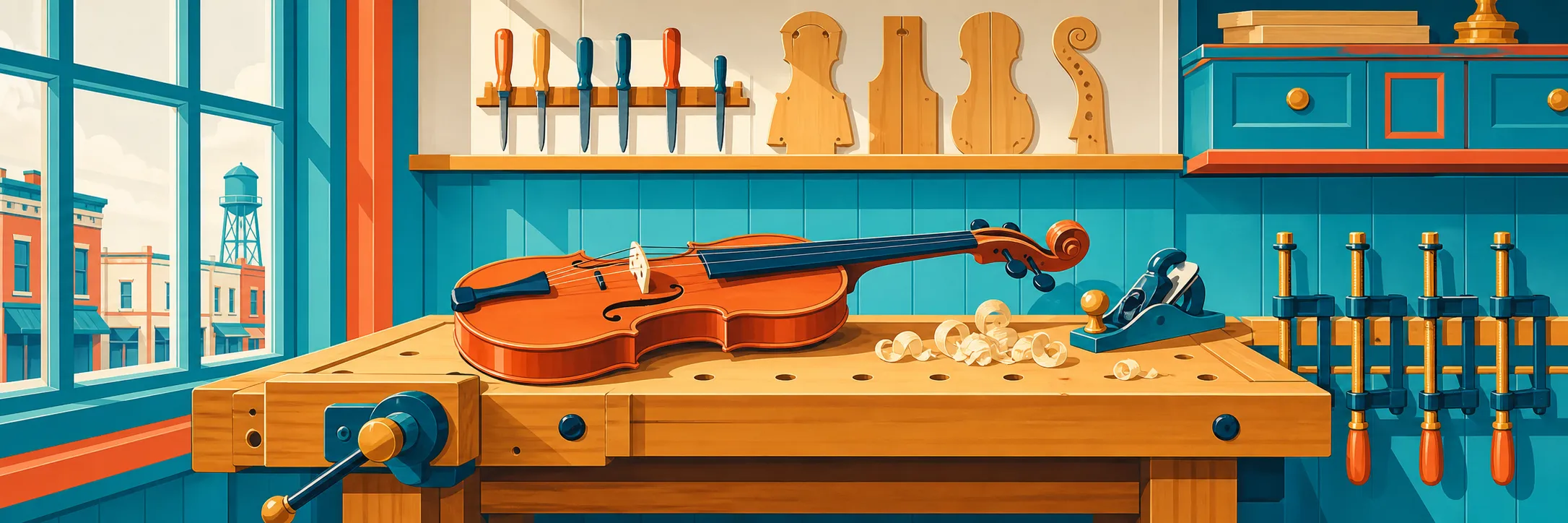
The fiddle lived on top of the tall cabinet in the front room, in a black case with two brass latches, and in the boy's whole memory it had never once come down. His grandfather kept it up there where a person needed the step stool to reach it, which meant nobody reached it. Nobody played it, either. The boy had never heard a note out of it and had stopped expecting to.
What his grandfather did with the fiddle was show it. The morning he left for the stock sale a man from down the road came by to settle up about a trailer, and before either of them got anywhere near the trailer the old man had steered him over to the cabinet and was pointing up at the case. "Finest spruce in the county," he told the man. Cut the winter before the boy's own father was born. He reached up and laid his hand flat on the lid and left it there a moment, the same as he would on the back of a good heifer at a sale, and he did not open it and he did not bring it down. He never did. He praised the wood and let a man look at the box, and that was the whole of it.
The boy had watched this go on for years and had drawn the sensible conclusion from it. The case stayed shut. There were pale lines in the dust on the cabinet top where it sat, and the lines never moved, because the case never moved. A thing that had not been opened in front of company in living memory was not going to open itself now. That was as near to a law of the house as the boy had.
His grandfather took the truck to the sale two towns over and said he would be back Thursday. That left the boy alone in the house until then, with the hens to let out and the garden to water and otherwise nothing he had to answer for.
It started with toast.
The boy liked it dark, darker than one pass through the toaster would get it, and that morning he pushed the lever down a second time and then stepped out to the porch to look at the weather while it worked. The toaster did the toast and then kept going. By the time the smell reached him the kitchen had a haze up near the ceiling and the little alarm in the hall was winding itself up to go off.
He did the sensible thing twice over. He waved a dish towel under the alarm until it gave up, and he went across the front room and threw the big window open to let the haze out. What he had not counted on was the wind. It had been out in the yard all morning with nowhere to go, and now it had somewhere. It came through the front room in one push, found the kitchen door standing open, and swung it hard into the frame.
The slam went through the whole house. The boy felt it come up through the floor. And on top of the tall cabinet, where the fiddle had sat untouched longer than he could remember, the case slid a half inch toward the edge on the strength of that one slam, and then another half inch, and then it went over and took the whole drop to the floor. The boy was standing in the kitchen doorway with the towel still in his hands when it happened.
He got to it fast. The case had come open when it landed, both latches sprung, and the fiddle lay half out of it on the floorboards. There were two cracks in the top, a long one and a short one, running down from where the bridge stood, its foot broken clean off under it so that the whole of it stood there and leaned. He crouched over the thing and did not touch it for a while. He had not been within ten feet of it when it broke. He had made toast.
There was glue in a drawer in the garage, and the boy knew right where. It was a yellow bottle he had seen his grandfather use on a chair rung once. When he dug it out, the glue had gone to a brick inside the bottle, the cap welded down, the whole of it no good to anybody and probably no good for a year or more. He set it back in the drawer out of respect and looked at what else there was.
There was tape. He held a fresh roll of it and thought the matter through, and the longer he thought the worse tape got. Tape was a thing anybody could see. It would sit on top of the wood where the first person to look would find it, and it would yellow, and one day it would let go and leave a gray mark behind in the finish, and then whoever found it would know two things instead of one, that the fiddle had been broken and that somebody had gone after it with tape. He put the tape back on the shelf too.
What settled the tape for good was the staple gun. His grandfather kept a big one for roofing in the garage, and the boy took it down and thought that here at last was a tool that put two things together and meant them to stay. He was not a fool about it. He wasn't going to try it on the fiddle first. He found a scrap of shelf board in the corner, stood it up, and pulled the trigger, and the staple drove most of the way through the board and into the wall behind, and a chunk of the board came off the bottom besides. He stood there holding the gun and understood that the roofing staple and the fiddle were never going to be introduced.
So he did it by hand. There was a box of small staples nearby, the kind a person presses in with a squeeze tool, and a fine brad in the drawer, and a tack hammer with a good balance to it. He worked out a method for it. He would lay a staple across a crack, prick a starter hole for each leg with the brad so the wood would not split, stand the legs in the holes, and tap them down with the tack hammer, one leg and then the other, until the staple pulled flush to the finish. The first one went in crooked and standing proud and he pried it out and started again. The second went in better. By the fourth he had the feel of it.
He got good at it. He had not set out to and could not have named the moment it started, but somewhere in the second row his hands had the job by heart, the brad and then the legs and then the two soft taps, and the staples began to go down straight. He looked at a finished row and saw it come out straight, and something in him that had nothing to do with fiddles took an interest. He began evening up the spaces between the staples so the row would look right, measuring them by eye, moving one that stood too near its neighbor. He stood back to look at it, as a man stands back from a floor he has just laid, and for a moment he forgot what he was doing it for.
In the middle of it a neighbor put his head in at the garage door, a man cutting through on his way to somewhere else, and stood a second looking at the boy bent over the fiddle with the tack hammer going. "Fixing it, are you," the man said. It was not really a question, and the boy did not really answer it, and the man went on to wherever he was headed.
The bridge was the one part that got the better of him. It was a little curved piece of maple that stood up under the strings and held them off the top, and its foot had broken so that it stood there and leaned to one side. A bridge was not a thing he could staple. He tried standing it up straight and it would not stay standing. In the end he stood it as near to upright as it would go and let it lean, and it leaned, and that was the one part of the whole job, in his mind, he could not make right.
That night he lay awake. He kept thinking of the door, and his grandfather coming through it Thursday, and himself standing there in front of him. He could tell him. He could meet the truck in the yard and own the whole business before the old man had his bag out of it. But he ran the telling through in his head and it came apart in the saying.
"The toast broke your fiddle."
There was no way to say it that did not come out wrong. "There was a scorched piece of bread and a window and a wind and a door, and then, at the end of all that, well, I stapled it." His grandfather would stand there and take it all in and come away certain that his fiddle was ruined and that his grandson had gone soft in the head.
So he thought about not telling him at all, and the more he thought about that, the better it sounded. The case had not come down off that cabinet in years. He knew it for a fact. The dust lines proved it, nobody in the house played a note, and nobody ever asked to have the fiddle out of its box. It went up there shut and it stayed up there shut. If he squared the case back on its dust lines and pressed the latches down, the thing would look from the floor exactly as it had always looked, which was a closed black case with a famous piece of wood inside it that no living person expected to see out. He could feel there was a hole in this somewhere. He could very nearly put a finger on it. But it was late, and the odds as he counted them ran long and steady in his favor, and a boy that age can talk himself well past a hole he cannot see at midnight.
In the morning he did it his way. He climbed up and squared the case back onto its dust lines so it sat where it had always sat, not a finger off in any direction. He pressed both latches down until they clicked. He swept the garage out. He put the tack hammer back on its nail, the brad back in the drawer, the box of small staples back behind the paint cans, and he stood in the middle of a clean garage with nothing left in it to say what had gone on there. Then he let the hens out and watered the garden and set in to wait for Thursday, feeling, on balance, that he had done a hard thing and come off all right.
His grandfather came home in fine spirits, and he did not come home alone. There was a second man in the truck with him, an old fellow he had fallen in with at the sale and got to talking, the kind of talking that does not finish inside one afternoon, so he had brought him home to carry it on over supper. The boy heard the two of them out in the yard before he saw them, and he put down the plate he was drying, because he knew what his grandfather did with company in the house.
The old man came through the door still talking and did not stop to put his bag down. He had his friend by the elbow and was steering him across the front room before the screen had banged shut behind them, telling him about the wood, the finest spruce in the county, cut the winter before the boy's father was born, and the boy stood in the kitchen doorway and watched it come on. His grandfather reached up and brought the case down off the cabinet, which the boy had seen him do maybe twice in his whole life, and set it on the table, and thumbed both latches up, and then, to show his friend the wood itself and not only the box that kept it, for the first time in the boy's memory, he opened the case.
The row of staples caught the afternoon light, all of them at once, the little galvanized backs of them in their straight lines down the top of the fiddle, evened up and flush and shining in the sun off the front window. For a moment nobody said anything. The friend leaned in for a better look at the finest spruce in the county. The grandfather looked at what he was showing. The boy, from the doorway, looked at the best work his hands had ever done, lit up on the table between two grown men.
The friend spoke first. "Well," he said. "That'll hold."
And whatever the boy had spent two days getting ready to say or to keep from saying went out of him all at once, and what came out instead was the whole of it in one breath, that he had wanted his toast dark and pushed the lever down twice and gone out to the porch to look at the weather and the toast had caught and smoked and set the alarm off so he threw the front window open to clear the haze and the wind had come in and slammed the kitchen door and the slam had knocked the case clean off the cabinet and the fiddle had cracked in two places and broken its bridge foot and the glue was a brick in the bottle and the tape would show and the roofing gun had gone straight through a shelf board so he had done it by hand with a brad and a tack hammer, and he was sorry, he was so sorry, he had only been making toast.
His grandfather heard the whole of it out without a word, and when the boy ran out of words, the old man was not looking at him. He was looking at the fiddle. He took the glasses out of his shirt pocket and put them on and bent down over the top of it and went down the rows with one finger. He looked a long while. The boy stood in the doorway and waited.
"Straight," the old man said at last. He said it more to the fiddle than to the boy. "Every one of them straight." Then he stood up and took the glasses off and looked at his grandson for the first time since he had come through the door. "Even spaced, too," he said.
From then on, his grandfather left it down where a person could reach it. When a friend came by, the case came down off the cabinet and opened on the table, and the old man would stand over the rows with his thumbs hooked in his belt. "My grandson did that," he would say.
Reinforced, he took to calling it. He would run a customer or a cousin or the fellow come to read the water meter over to the table and open the case and show them the wood, same as ever, the finest spruce in the county, and then he would turn it to the light so the staples showed and tell them whose work it was and how old the boy had been at the time. Someday when there was the money they would take it to a man who did such work and have the top off and the cracks done properly, he would say. In the meantime there it was on the table, open, the boy's work showed in the light.
The boy died a little every time it happened. There is no plainer way to put it. He would be crossing the front room on some errand and hear his grandfather winding up at the table, the finest spruce in the county, and he would know what was coming next, and he would keep on walking and wish to himself that the case had a lock on it.
The last time anybody tells of this happening, it was a man come out to look at a heifer, no different from the first morning of the whole business except turned entirely around. The two of them never got anywhere near the barn. The old man had him by the elbow and over to the table, and the case came down, and the latches went up, and the lid came up after them. He turned the fiddle to the window so the steel caught the light first thing, before there was any mention of the wood.
The boy just stood in the doorway where he always stood, and watched his grandfather show a stranger the best work his hands had ever turned out, as he ate his morning toast.